1.4×
Time to every acceptance criterion
a 40-hour week becomes 28 hours
 Claude Code working✶ Claude Code❯ Make checkout recoverablesrc/Checkout.tsx⎿ Read src/Checkout.tsx● Tracing payment states…⎿ Edit src/Checkout.tsx +38 −12✻ Cooked for 2m 18smain0 collisions
 Codex working›_ OpenAI Codex› Refactor preview lifecyclesrc/Preview.tsx• Explored 7 files• Claimed src/Preview.tsx↳ Edited preview recovery✓ 24 tests passedmain0 collisions
 Kimi working◈ Kimi Code❯ Unify the design systemsrc/styles/app.css✦ Scanning tokens and surfaces╭ src/styles/app.css╰ Responsive grid updated +18 −6✓ Ready for reviewmain0 collisions
 Cursor Agent working◆ Cursor Agent› Polish the onboarding flowsrc/onboarding/Welcome.tsx↳ Searched onboarding routes● Updating first-run copy…+ Added transition states✓ Lint cleanmain0 collisions
−50%tokens50% fewer tokens
1.4×faster delivery1.4 times faster delivery
0git conflictsno git conflicts
The benchmark
Same project, same model, with and without Murmell.
1.4×
a 40-hour week becomes 28 hours
−55%
−50%
0
One benchmark run, October 2026: same project, same model, two simulated developers, each running three coding agents.
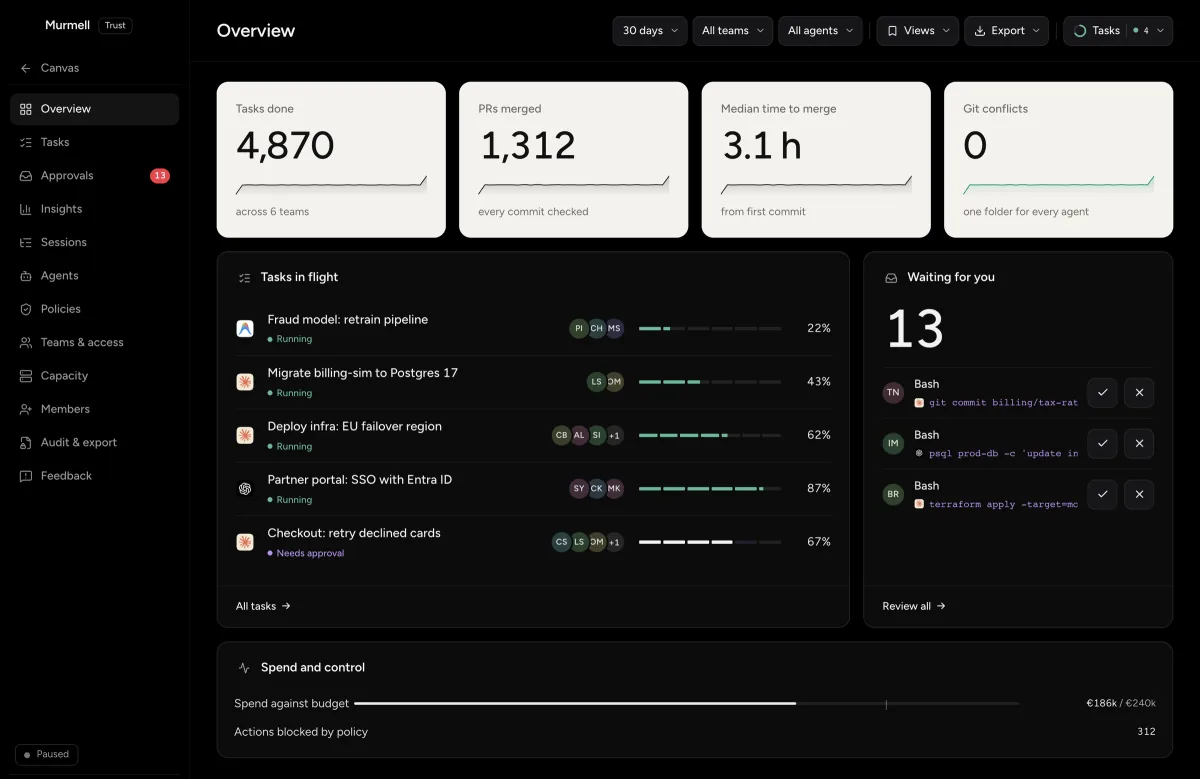
Install Murmell on your own infrastructure. Choose which agents your teams may use, with policies, sealed secrets, approvals, an audit log and usage per person.









The canvas makes parallel agents understandable before it makes them faster.
I can close my laptop, come back later, and the whole build is still where I left it.
It feels less like supervising terminals and more like working in the same room.
I finally know what every agent is doing without opening four different tools.
Sharing the live room is much clearer than sending another terminal recording.
The project stays warm in the cloud, so returning to the work takes seconds.
File reservations make parallel work feel controlled instead of risky.
Watching the canvas tells me more than another stream of agent logs ever did.
It is the first multi-agent setup I can explain to a teammate in one screen.
I can move between Claude and Codex without losing the state of the project.
Murmell is a browser canvas where several AI coding agents (Claude Code, Codex, Cursor, Kimi, OpenCode) run on a cloud machine and share one project directory. Each agent opens in its own window with a real terminal, and everyone on the link sees the same canvas as it happens.
Yes. Everyone on the link sees the same room: who joined, which window they are watching, where their cursor is. Each person drives their own agents, and nothing has to be replayed or refreshed to stay in step.
On a machine Murmell runs, in one directory, and in a private GitHub repository created with the project. The workspace is disposable and the repository is not: the work is pushed before a machine is ever torn down.
Murmell Canvas is available by invitation. Request access to arrange a demo with your team. Existing users can continue to sign in.
Murmell Bots are autonomous cloud agents for tasks and routines. They will work without an open Canvas and reuse the provider connections already linked to Murmell. Bots and the Canvas + Bots bundle are coming soon.
No. You connect the agent subscriptions and API keys you already pay for. Murmell charges for the machine and the collaboration, never for the model.
An agent claims the paths it is about to touch before it writes. A watcher attributes every write back to whoever made it, and a colliding write is snapshotted before it lands, so nothing is lost. The rule is enforced by the machine rather than suggested to the model.
Yes. Every canvas runs on its own machine, separate from every other project Murmell hosts. The machine that executes agent code holds no database and no decryption key.
Claude Code, Codex, Cursor, Kimi and OpenCode today, each in its own terminal on the canvas, signed in with your own account or API key. Adding an agent is adding a tile: nothing about the canvas changes.
Discuss your private cloud or on-premise requirements with our team when requesting access. Your code remains in a private repository you own.